
 Ready to showcase our unparalleled expertise and unparalleled product range to customers around the world.
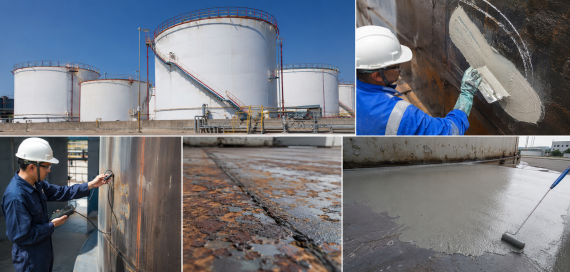
Large storage tanks are often among the most overlooked critical assets in an industrial facility.
1. Different Tanks, Different Risks
There is no single category of “industrial storage tank.”
Tank geometry, construction materials, stored product, operating conditions, pressure, temperature, roof configuration, foundation and environmental exposure all influence the degradation mechanisms that may develop during service.
Some of the most common applications include:
Atmospheric Storage Tanks
Large vertical atmospheric tanks are widely used throughout the oil & gas, petrochemical, chemical, mining, power generation, water and manufacturing industries.
Depending on the application, they may feature fixed roofs, internal floating roofs or external floating roofs.
API 650 is a key reference for the design and construction of certain vertical, cylindrical, welded steel storage tanks operating at or near atmospheric pressure.
Water Storage Tanks
Used in water treatment, mining, utilities, power generation, steelmaking, food processing and industrial facilities.
Corrosion, coating degradation, structural deformation, foundation movement and deterioration around welded areas can all affect long-term reliability.
Fuel and Petroleum Product Tanks
Diesel, gasoline, jet fuel, crude oil, naphtha, fuel oil and other hydrocarbons require careful control of corrosion and integrity.
Tank bottoms, shell courses, roofs, weld seams, nozzles and areas around the liquid-vapor interface can require particular attention.
Chemical Storage Tanks
Chemical facilities may store acids, caustics, solvents, reagents and highly aggressive process fluids.
In these applications, wall-thickness measurements alone may not provide the complete picture.
Chemical compatibility, operating temperature, concentration, coating condition and the specific corrosion mechanism must also be considered.
Process Tanks
Some tanks are not simply storage vessels.
They may be involved in mixing, separation, settling, treatment or other process operations.
This can introduce additional mechanical, chemical and abrasion-related stresses.
Mining Tanks
Mining operations can use large tanks for process water, slurry, reagents, chemical solutions and other fluids associated with mineral processing.
The combination of corrosion, erosion and abrasion can create particularly challenging service conditions.
Waste and Effluent Tanks
Wastewater, process residues and other industrial waste streams may contain corrosive chemicals, suspended solids, gases and contaminants.
Their composition may also change significantly during operation.
The result is an important principle:
The same visual indication can have completely different causes — and therefore require completely different repair strategies.
2. Where Do Tank Problems Usually Begin?
Deterioration can occur almost anywhere on a tank, but some areas deserve particular attention.
Tank Bottoms
Tank bottoms are among the most critical areas for corrosion management.
Moisture, contaminants, product residues, differential conditions and interaction with the foundation can contribute to localized or generalized corrosion.
Inspection can also be challenging because internal examination often requires the tank to be removed from service, emptied, cleaned and prepared for safe entry.
This is one reason why tank-bottom integrity management is such an important part of long-term asset reliability.
Shell
The tank shell may experience:
API 653 provides requirements for maintaining the integrity of applicable aboveground storage tanks after they have been placed in service, including inspection, repair, alteration and reconstruction.
Roofs
Fixed and floating roofs can experience corrosion, water accumulation, coating deterioration, mechanical damage, drainage problems and deterioration of structural components.
Floating roof seals and associated components can introduce additional inspection requirements.
Nozzles and Connections
Nozzles deserve special attention because they combine geometric discontinuities, welds, localized stresses and connections to piping systems.
A localized defect in these areas may therefore have consequences beyond the tank wall itself.
Welded Joints
Welds may be affected by cracking, localized corrosion, fabrication discontinuities or other degradation mechanisms.
The appropriate inspection method depends on the suspected flaw and the material involved.
Foundation and Tank-to-Foundation Interface
Not every tank integrity problem begins with corrosion.
Differential settlement can alter tank geometry, create additional stresses, deform the bottom and transfer loads to the shell, nozzles and connected piping.
This is why structural integrity and corrosion management should not be treated as completely separate subjects.
3. How Should a Tank Problem Be Diagnosed?
One of the most common maintenance mistakes is to start with the repair.
A more effective approach is to start with the diagnosis.
The inspection strategy may combine several non-destructive examination techniques.
Visual Inspection
Visual inspection is usually the first line of investigation.
Inspectors may look for:
However, visual inspection alone cannot establish the structural condition of the tank.
Ultrasonic Thickness Measurement — UT
UT is widely used to determine remaining wall thickness.
But the most important question is not simply:
“How thick is the steel today?”
It is:
“How much material has been lost, how quickly is it being lost, and what does that mean for the tank's remaining service life?”
Historical thickness data can therefore be extremely valuable for establishing corrosion rates and planning future inspections.
Magnetic Flux Leakage — MFL
MFL technology is commonly used for screening large areas of tank bottoms.
It can help identify areas of potential metal loss that can then be investigated using other inspection techniques.
Magnetic Particle and Liquid Penetrant Testing
These methods can be useful for identifying surface-breaking discontinuities, particularly around welds and other critical areas, depending on the material and suspected damage mechanism.
Advanced Ultrasonic and Radiographic Techniques
Depending on the situation, more advanced examination methods may be required to evaluate welds, internal discontinuities or localized degradation.
Settlement and Geometric Surveys
Dimensional surveys can identify tank deformation and settlement that may not be obvious from a conventional visual inspection.
4. From Inspection to Engineering Assessment
Finding wall loss does not automatically mean that the tank must be taken out of service.
The next question is:
Can the tank safely continue operating under the current conditions?
This is where Fitness-for-Service assessment can become particularly valuable.
API 653 recognizes Fitness-for-Service concepts for evaluating in-service degradation, while API 579-1/ASME FFS-1 provides detailed methodologies for assessing damaged equipment and determining whether it can continue operating under defined conditions.
The assessment may consider:
The objective is not simply to determine whether a tank is “good” or “bad.”
It is to establish the engineering condition of the asset and the appropriate course of action.
5. Not Every Thickness Loss Requires Plate Replacement
This is one of the most important decisions in tank maintenance.
Corrosion does not automatically mean that the damaged steel must be cut out and replaced.
Depending on the damage mechanism, location, extent, remaining thickness and engineering assessment, several approaches may be considered.
Monitoring
Appropriate when the existing condition remains acceptable and sufficient margin exists for continued operation and periodic inspection.
Protective Coatings
Useful when the substrate remains suitable and the primary objective is to control further corrosion or restore a protective barrier.
Localized Repair
Applicable when the deterioration is limited to a defined area and the component can be safely restored without extensive reconstruction.
Metallic Reinforcement
Depending on the engineering assessment, solutions may include reinforcement plates, inserts, sleeves or other engineered metallic repairs.
Plate Replacement
May be required when the remaining material or damage condition no longer supports a safe repair using other techniques.
Composite Repair Systems
In selected applications, non-metallic composite systems may be considered for localized reinforcement, restoration or containment.
ASME PCC-2 provides repair methods for in-service equipment and piping and specifically includes articles addressing nonmetallic composite repair systems.
The key point is:
The repair method should be selected after understanding the damage mechanism — not before.
6. When Can Composite Repair Systems Make Sense?
Composite repair technology has become increasingly relevant in industrial maintenance because it can provide alternatives to more invasive repair methods in selected applications.
Depending on the system design and engineering requirements, composite solutions may be considered for:
However, there is a major difference between:
applying a polymer material over a corroded area
and
performing an engineered composite repair.
A properly designed repair may need to consider:
In other words:
A material does not define the repair. The engineering assessment does.
7. What Changes When the Tank Is Leaking?
A leak changes the situation immediately.
The first objective is to establish:
Where is the leak coming from?
What caused it?
Is the damage stable or progressing?
Does it affect structural integrity?
What is the stored product?
Is the product flammable, toxic or corrosive?
Can the repair be performed safely under operating conditions?
Depending on the circumstances, an interim intervention may be required to stabilize the asset until a permanent repair can be performed.
In other situations, immediate shutdown may be necessary.
The decision between welding, plate replacement, mechanical reinforcement, composite repair, sealing or another technology should never be based solely on application speed.
The priority is restoring integrity through a technically justified repair strategy.
8. The Hot Work Challenge
Welding remains one of the most important technologies in industrial maintenance.
However, hot work can introduce significant complexity when performed on or around tanks containing or previously containing flammable, toxic or hazardous products.
Depending on the application, preparation may include:
For large tanks, these activities can significantly increase the overall duration and cost of an intervention.
This is one reason why cold-applied repair technologies can be attractive in selected scenarios.
When technically applicable, they may reduce some of the activities associated with conventional hot work.
But “cold repair” does not mean “simple repair.”
The asset condition, loading, product compatibility, surface condition and required performance must still be properly evaluated.
9. The Cost of the Problem Is Often Bigger Than the Repair
When evaluating the financial impact of tank deterioration, the maintenance invoice is only one part of the equation.
The actual cost may include:
Cleaning + preparation + scaffolding + mobilization + inspection + repair + testing + logistics + product loss + production loss + environmental management + asset downtime.
For a critical tank, the largest cost may not be the repair itself.
It may be the loss of availability.
Consider a tank used to store a raw material that feeds a continuous production process.
If that tank becomes unavailable, the impact can extend throughout the plant.
This is why early detection and localized intervention can have significant economic value.
A relatively small repair performed at the right time may prevent a much larger intervention later.
10. A Practical Decision Matrix
Condition
Initial approach
Potential technologies
o Coating deterioration with sound steel
o Restore corrosion protection
o Surface preparation + coating
o Localized surface corrosion
o Control corrosion mechanism
o Coating or polymeric protection
o Localized wall thinning
o Engineering assessment
o Local repair, composite or metallic reinforcement
o Extensive wall thinning
o Structural assessment
o Plate replacement or engineered reinforcement
o Weld cracking
o NDE + engineering assessment
o Weld repair or replacement
o Localized leakage
o Immediate diagnosis
o Sealing, localized repair or replacement
o Shell deformation
o Structural assessment
o Geometry correction, reinforcement or reconstruction
o Foundation settlement
o Geotechnical + structural assessment
o Foundation correction + associated repairs
o Recurring corrosion
o Identify root cause
o Corrosion control + coating/protection
o Contaminated repair area
o Evaluate cold-repair feasibility
o Engineered polymeric/composite systems where applicable
This matrix is not a substitute for engineering assessment.
Its purpose is to illustrate a fundamental principle:
Different damage mechanisms require different repair strategies.
11. Technology Should Follow the Damage Mechanism
There is no universal repair technology for industrial tanks.
Sometimes the best solution is to replace a plate.
Sometimes it is to restore a coating.
Sometimes it is to install a metallic reinforcement.
Sometimes a composite system may provide an effective alternative.
And sometimes the best decision is to continue operating under a controlled inspection and monitoring program.
API 653 provides a framework for inspection, repair, alteration and reconstruction of applicable in-service storage tanks. API 579-1/ASME FFS-1 can support engineering assessments when a more detailed evaluation of degradation and remaining life is required.
This leads to one of the most important principles in modern asset integrity:
Technology should be the consequence of diagnosis — not the starting point of the diagnosis.
12. Where Do High-Performance Polymer Composites Fit?
Advances in industrial materials have created new options for maintenance teams looking to restore damaged components without necessarily replacing large sections of steel.
High-performance polymer composites can combine a polymeric matrix with mineral, ceramic or other reinforcing components to address different deterioration mechanisms.
Depending on their formulation and engineering design, these systems can be used for applications such as:
In some applications, the ability of a repair system to bond to challenging surfaces can also provide an important operational advantage.
This is particularly relevant when conventional surface preparation or complete contamination removal is difficult.
However, the same principle remains valid:
A high-performance material does not replace engineering judgment.
The repair system must be selected, designed and applied according to the specific service conditions.
13. A Better Tank Integrity Strategy
A mature tank integrity program can be organized around six fundamental steps.
1. Know the Asset
Understand the original design, construction materials, operating history, stored product, coatings, previous repairs and service conditions.
2. Identify the Damage Mechanisms
Determine whether the primary threats are corrosion, erosion, abrasion, cracking, coating failure, deformation, settlement, chemical attack or a combination of mechanisms.
3. Measure
Use UT, MFL, visual inspection, NDE, dimensional surveys and other appropriate technologies.
4. Assess
Determine remaining thickness, corrosion rate, criticality, structural condition and estimated remaining life.
5. Select the Repair Strategy
Depending on the assessment:
Monitor → Protect → Repair → Reinforce → Replace
6. Verify and Monitor
Perform the required examination and testing after the intervention and establish an appropriate follow-up inspection program.
This approach reduces the likelihood of turning a manageable maintenance issue into an emergency shutdown.
14. Tank Integrity Is Ultimately Risk Management
A tank does not have to leak to be in a critical condition.
A relatively small thickness loss may be associated with a high corrosion rate.
A minor-looking deformation may indicate a foundation problem.
A failed coating may be merely cosmetic — or the beginning of accelerated corrosion.
A small pit may be insignificant in one location and critical in another.
A localized defect near a nozzle or weld may have very different consequences from the same defect in a low-stress area.
This is why tank integrity should be managed as a continuous process:
Inspect → Measure → Understand → Assess → Repair → Monitor
There is no single technology capable of solving every tank integrity problem.
There is, however, a powerful combination of:
Engineering + Inspection + Materials + Damage Mechanism Knowledge + Proper Execution
The earlier these elements come together, the greater the opportunity to preserve the asset, reduce repair scope, minimize downtime and prevent a localized deterioration mechanism from becoming a major operational event.
Conclusion
Large industrial tanks are designed to operate for decades.
But long service life does not mean freedom from deterioration.
Corrosion, wall thinning, erosion, coating failure, cracking, deformation, leakage and foundation problems are all part of the challenges that asset owners must manage throughout the life of a tank.
The objective of modern maintenance should not simply be:
“Repair it when it fails.”
It should be:
“Identify deterioration before failure, understand the mechanism, assess the risk and select the most appropriate intervention to preserve integrity and availability.”
This is where advanced repair technologies, including high-performance polymeric and composite systems, can play an increasingly important role.
When properly specified and engineered, these technologies may provide valuable alternatives for selected repair, reinforcement, protection and restoration applications — particularly when reducing downtime, minimizing intervention and avoiding unnecessary hot work are important factors.
Because repairing a tank is not simply about restoring steel.
It is about protecting the continuity of the operation.
Technical References
Integrity, Performance, and Cost Reduction in Offshore, Steel, Oil & Gas, and Other Industrial Sectors
Read More
From offshore platforms and refineries to mining plants and gas processing facilities, pressure, chemical attack, erosion, and operational stress continue to compromise critical assets every day.
Read More

 Back
Back
