
 Ready to showcase our unparalleled expertise and unparalleled product range to customers around the world.
From offshore platforms and refineries to mining plants and gas processing facilities, pressure, chemical attack, erosion, and operational stress continue to compromise critical assets every day.
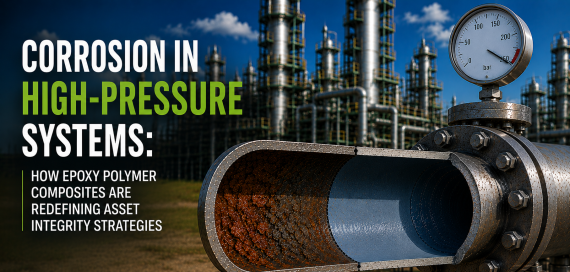
In industrial operations, corrosion in high-pressure systems remains one of the most critical challenges for asset integrity and operational reliability.
Industries across continents — including oil and gas, petrochemical, mining, power generation, steel production, and heavy process industries — operate with equipment that is continuously exposed to:
According to internationally recognized practices from organizations such as the Association for Materials Protection and Performance, corrosion in pressurized systems is rarely caused by a single factor. Instead, it results from the interaction between chemical attack, mechanical stress, erosion, pressure fluctuation, and operational wear.
In this context, epoxy-based polymer composites have become a proven engineering solution for restoring, protecting, and extending the service life of critical industrial assets.
1. Corrosion in Process Vessels (Refining, Gas Processing, Hydrometallurgy)
Damage Mechanism
Process vessels operating under high internal pressure are constantly exposed to chemically aggressive fluids, gas compression cycles, and mechanical stress.
Common degradation mechanisms include:
In pressurized environments, even localized corrosion can rapidly evolve into structural integrity risks.
Industry Impact
Engineering Solution
Max 5412 is recommended as a primary structural repair material. As a metal-reinforced epoxy composite, it is ideal for:
For chemical protection, Max 1552 provides a ceramic-reinforced barrier against aggressive process fluids and corrosive environments.
2. Chemical Attack in High-Pressure Gas Scrubbers (Steel, Fertilizers, Mining)
Damage Mechanism
Gas scrubbers operating under pressure are exposed to one of the most aggressive combinations found in industrial processing:
These conditions accelerate wet corrosion, erosion, and internal surface degradation.
Industry Impact
Engineering Solution
Max 2361, a novolac ceramic-reinforced epoxy composite, is specifically engineered for chemically aggressive pressurized environments.
It provides:
This approach aligns with modern integrity management practices adopted across global industrial sectors.
3. Erosion-Corrosion in Heat Exchangers (Energy, Oil & Gas, Mining)
Damage Mechanism
In high-pressure heat exchanger systems, corrosion is intensified by:
The continuous removal of protective oxide films exposes fresh metal surfaces, accelerating deterioration.
Industry Impact
Engineering Solution
Max 1511 is a ceramic-reinforced epoxy composite developed for:
For flow optimization and reduced friction loss, Max 1512 provides a smoother hydraulic surface, helping improve system efficiency.
4. Flanges and Nozzles Exposed to High Pressure
Damage Mechanism
Flanges and nozzles are critical stress concentration areas in pressurized systems.
These regions are highly vulnerable to:
Under pressure, even small surface defects can evolve into major containment failures.
Industry Impact
Engineering Solution
Max 5412 is ideal for precision rebuilding and restoration of damaged flange surfaces and nozzle areas.
For emergency repairs, Max 5611, 5511 and 5631 enables:
This supports risk-based maintenance and reliability-centered asset management strategies.
5. Corrosion in High-Pressure Pipelines (Oil Pipelines, Slurry Transport, Steam Systems)
Damage Mechanism
High-pressure pipelines are exposed to multiple simultaneous degradation mechanisms:
This combination creates severe integrity challenges in long-distance transport systems.
Industry Impact
Engineering Solution
A combined protection strategy is recommended:
This integrated system improves reliability while reducing shutdown frequency and operational risk.
6. Corrosion Under Insulation (CUI): A Global Industry Challenge
Damage Mechanism
CUI remains one of the most difficult forms of corrosion to detect in pressurized industrial systems.
It occurs when:
Because the degradation remains hidden, failures often occur unexpectedly.
According to the Association for Materials Protection and Performance, CUI is one of the leading causes of unexpected asset failure worldwide.
Engineering Solution
The recommended protection system includes:
This system creates a durable moisture-resistant barrier, significantly reducing hidden corrosion risks in insulated pressurized systems.
Important:
The recommended solutions for using Maxepoxy products are standard suggestions. It is always recommended that a thorough analysis of each case be carried out before choosing the product to be applied, in order to achieve maximum efficiency and effectiveness of the epoxy resin in the applied repair.
Conclusion: From Reactive Maintenance to Asset Integrity Engineering
Corrosion in high-pressure industrial systems should no longer be treated as a simple maintenance issue.
Modern epoxy polymer composites provide industries with a practical and field-proven engineering solution capable of:
Across continents, industries are increasingly adopting composite repair technologies as part of broader asset integrity and reliability strategies aligned with international best practices.
“Based on industry practices adopted by AMPP, API, ASME and global asset integrity standards.”
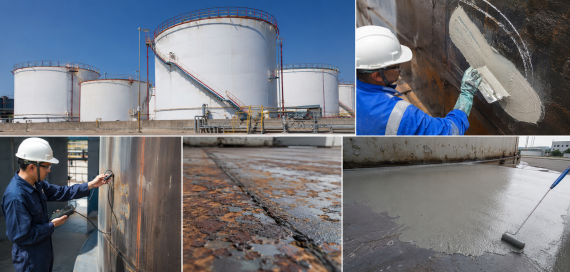
Large storage tanks are often among the most overlooked critical assets in an industrial facility.
Read More
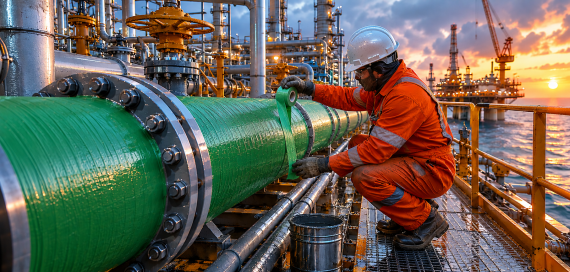
Integrity, Performance, and Cost Reduction in Offshore, Steel, Oil & Gas, and Other Industrial Sectors
Read More

 Back
Back
