
 Ready to showcase our unparalleled expertise and unparalleled product range to customers around the world.
Hidden Degradation Mechanisms and Integrity Risks in Critical Industrial Piping Systems
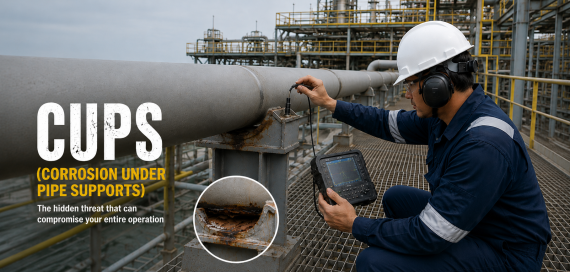
In industrial sectors such as oil & gas, offshore, mining, petrochemical processing and power generation, some of the most critical piping degradation mechanisms develop precisely in regions that are difficult to inspect and frequently underestimated during routine maintenance activities.
Among these mechanisms, CUPS (Corrosion Under Pipe Supports) has become a major integrity concern due to its hidden nature, accelerated localized attack and potential to generate severe operational, environmental and financial consequences.
Pipe supports are essential structural components designed to sustain piping loads, absorb thermal expansion and maintain mechanical stability. However, these same regions often create ideal conditions for corrosion initiation and propagation.
The interface between pipe and support frequently retains:
Combined with coating degradation, cyclic vibration, thermal cycling and restricted accessibility, these conditions accelerate localized external corrosion mechanisms capable of compromising pipe wall integrity in relatively short periods.
Why CUPS Remains One of the Most Difficult Corrosion Mechanisms to Detect
Unlike generalized corrosion, CUPS typically develops in concealed contact regions where direct visual inspection is limited or completely obstructed.
In many industrial facilities, corrosion progresses underneath:
As a consequence, pipelines may appear externally intact while severe localized wall loss is already occurring beneath the support interface.
The situation becomes considerably more critical in:
Several studies conducted by integrity management organizations indicate that support locations consistently rank among the highest-risk regions for external corrosion-related failures in process piping systems.
Industrial Consequences and Historical Failure Cases
The economic impact associated with corrosion-related failures is enormous.
According to studies published by NACE International (currently AMPP), the global annual cost of corrosion exceeds US$ 2.5 trillion, representing approximately 3–4% of the world's GDP.
Although not all incidents are publicly categorized specifically as CUPS failures, numerous industrial accident investigations identified localized external corrosion at support regions as contributing factors.
Offshore and Oil & Gas Industry
Corrosion-related piping failures have historically contributed to:
One of the most referenced cases in process safety history remains the Piper Alpha disaster in the North Sea (1988), where failures involving hydrocarbon systems escalated into catastrophic explosions, resulting in 167 fatalities and billions in losses.
In refinery operations worldwide, localized external corrosion under supports and insulation has repeatedly generated:
According to several integrity management reports, unplanned shutdown costs in offshore production environments may exceed:
Mining Industry
Mining environments create particularly aggressive conditions due to:
Failures in slurry pipelines and process lines may lead to:
In large mining operations, a single critical pipeline shutdown can generate losses reaching hundreds of thousands of dollars per hour depending on throughput capacity.
Modern Inspection Technologies for CUPS Detection
Because conventional visual inspection alone is insufficient, advanced Non-Destructive Testing (NDT) technologies have become essential for early detection and integrity assessment.
Ultrasonic Thickness Testing (UT)
Still considered one of the primary inspection techniques for detecting localized wall loss and monitoring corrosion rates.
Phased Array Ultrasonic Testing (PAUT)
Provides improved defect characterization and higher-resolution inspection capabilities compared to conventional UT.
Guided Wave Ultrasonic Testing (GWUT)
Widely applied in long-range pipeline inspection and difficult-access regions, allowing extensive screening without full support removal.
Pulsed Eddy Current (PEC)
Particularly valuable for inspection through insulation and support interfaces, minimizing insulation removal requirements and reducing operational downtime.
Digital Radiography (DR) and Computed Radiography (CR)
Used to evaluate hidden wall loss, especially in inaccessible support contact regions.
Thermography
Supports identification of moisture retention and thermal anomalies associated with corrosion development beneath supports and insulation.
Drone-Assisted and Robotic Inspection Systems
Increasingly adopted in offshore and confined-space environments to improve safety and inspection efficiency.
Standards, Codes and Integrity Programs
Industrial piping inspection programs are typically governed by internationally recognized standards and integrity frameworks.
Among the most relevant references are:
API 570 – Piping Inspection Code
Covers:
API 571 – Damage Mechanisms Affecting Fixed Equipment
Provides technical guidance regarding corrosion and degradation mechanisms affecting industrial assets.
API 574 – Inspection Practices for Piping Components
Addresses inspection methodologies and examination techniques for piping systems.
API 579 / ASME FFS-1
Widely used for Fitness-For-Service evaluations and structural integrity assessments.
ASME B31.3
Defines process piping engineering and design requirements.
ISO 17024
International framework for certification programs involving qualified inspection professionals.
In parallel, several inspection personnel certifications are commonly required in integrity programs:
Prevention Remains the Most Cost-Effective Strategy
Despite technological advances in inspection methodologies, prevention continues to represent the most efficient long-term approach.
Best practices include:
High-Performance Protective Coatings
Advanced epoxy and polymeric systems designed to resist:
Improved Support Design
Modern support engineering focuses on:
Predictive Integrity Management
Risk-Based Inspection (RBI) methodologies enable prioritization of high-risk regions before critical degradation occurs.
Vibration Control
Mitigating cyclic mechanical movement reduces coating damage and metal exposure.
Digital Integrity Monitoring
Integration of digital inspection databases, predictive analytics and corrosion monitoring technologies is increasingly becoming part of Industry 4.0 integrity strategies.
Final Considerations
CUPS is far more than a localized maintenance issue.
It represents a complex integrity challenge capable of compromising operational reliability, safety performance, environmental protection and long-term asset availability.
As industrial sectors continue pursuing higher operational efficiency, ESG compliance and reliability-centered maintenance strategies, early detection and prevention of hidden corrosion mechanisms become increasingly critical.
In environments where a single unplanned shutdown may represent millions in losses, investing in advanced inspection technologies, qualified integrity programs and high-performance protective systems is no longer optional — it is a strategic operational necessity.
“Based on industry practices adopted by AMPP, API, ASME and global asset integrity standards.”
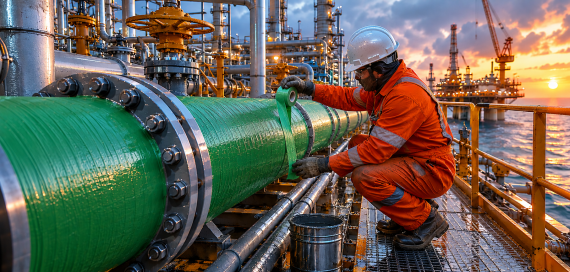
Integrity, Performance, and Cost Reduction in Offshore, Steel, Oil & Gas, and Other Industrial Sectors
Read More
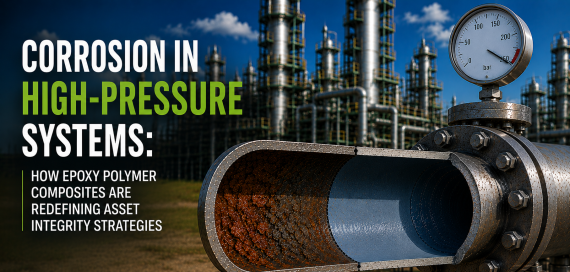
From offshore platforms and refineries to mining plants and gas processing facilities, pressure, chemical attack, erosion, and operational stress continue to compromise critical assets every day.
Read More

 Back
Back
